| The Bank of North Dakota (BND) is a state-owned and -run financial institution based in Bismarck, North Dakota. Under state law the bank is the State of North Dakota doing business as the Bank of North Dakota. The state and state agencies are required to place their funds in the bank, local governments are not required to do so. Previously, all public corporations in the state were also required to deposit their funds in the bank, but an initiative measure in 1919 eliminated that requirement[citation needed]. Other entities may also open accounts at the Bank; however, BND offers fewer retail services than other institutions, and has only one office, limiting its competitiveness in consumer banking. Instead, BND has taken a role more akin to a central bank, and has many functions, such as check clearing, that might be expected from a branch office of the Federal Reserve. The Bank does have an account with the Federal Reserve Bank, but deposits are not insured by the Federal Deposit Insurance Corporation, instead being guaranteed by the general fund of the State of North Dakota itself and the taxpayers of the State. BND also guarantees student loans (through its Student Loans of North Dakota division), business development loans, and state and municipal bonds. Though initially conceived by Non-Partisan League populists as a credit union-style institution to free the farmers of the state from predatory lenders, the Bank's functions were largely neutered by the time of its inception by the business-backed Independent Voters Association. The recall of NPL Governor Lynn Frazier effectively ended the initial plan, with BND taking a more conservative central banking role in state finance. The current president and CEO is Eric Hardmeyer, however the bank is managed by the North Dakota Industrial Commission, which is composed of the Governor, Attorney General, and the Agriculture Commissioner(formerly the Agriculture and Labor Commissioner) of North Dakota[1]. The Bank of North Dakota is the only state-owned facility of its type in the United States other than the Puerto Rico Government Development Bank. http://en.wikipedia.org/wiki/Bank_of_North_Dakota |
Wednesday, December 1, 2010
THE UNITED STATES IS A CORPORATION CHAPTER TITLE AND VERSE NORTH DAKOTA HAS IT'S OWN BANK OUTSIDE OF THE FED CATCHING ON!
The specific laws enacting the United States Corporation are spelled out from 1871. You are their chattel traded like a commodity.

Did the State Pledge Your Body to a Bank?
FORT FAIRFIELD JOURNAL
Real. Educational. News.
Fort Fairfield Journal Contact Us Bible Reference Our Library
| Advanced Civics Research Library
Structure of the Birth Certificate Did the State Pledge Your Body to a Bank?
Right: Some birth and marriage certificates are now "warehouse receipts," printed on banknote paper, which may mark you and yours as 'chattel' property of the banks that our government borrows from every day. |  |
| ||
| By: David Deschesne Editor, Fort Fairfield Journal Fort Fairfield Journal, May 11, 2005 A certificate is a "paper establishing an ownership claim." - Barron's Dictionary of Banking Terms. Registration of births began in 1915, by the Bureau of Census, with all states adopting the practice by 1933.Birth and marriage certificates are a form of securities called "warehouse receipts." The items included on a warehouse receipt, as descried at §7-202 of the Uniform Commercial Code, the law which governs commercial paper and transactions, which parallel a birth or marriage certificate are: -the location of the warehouse where the goods are stored...(residence) -the date of issue of the receipt.....("Date issued") -the consecutive number of the receipt...(found on back or front of the certificate, usually in red numbers) -a description of the goods or of the packages containing them...(name, sex, date of birth, etc.) -the signature of the warehouseman, which may be made by his authorized agent...(municipal clerk or state registrar's signature) Birth/marriage certificates now appear to at least qualify as "warehouse receipts" under the Uniform Commercial Code. Black's Law Dictionary, 7th ed. defines:warehouse receipt. "...A warehouse receipt, which is considered a document of title, may be a negotiable instrument and is often used for financing with inventory as security." Since the U.S. went bankrupt in 1933, all new money has to be borrowed into existence. All states started issuing serial-numbered, certificated "warehouse receipts" for births and marriages in order to pledge us as collateral against those loans and municipal bonds taken out with the Federal Reserve's banks. The "Full faith and Credit" of the American people is said to be that which back the nation's debt. That simply means the American people's ability to labor and pay back that debt. In order to catalog its laborers, the government needed an efficient, methodical system of tracking its property to that end. Humans today are looked upon merely as resources - "human resources," that is. Governmental assignment of a dollar value to the heads of citizens began on July 14, 1862 when President Lincoln offered 6 percent interest bearing-bonds to states who freed their slaves on a "per head" basis. This practice of valuating humans (cattle?) continues today with our current system of debt-based currency reliant upon a steady stream of fresh new chattels to back it. Additional Birth Certificate Research Federal Children by Joyce Rosenwald In 1921, the federal Sheppard-Towner Maternity Act created the birth "registration" or what we now know as the "birth certificate." It was known as the "Maternity Act" and was sold to the American people as a law that would reduce maternal and infant mortality, protect the health of mothers and infants, and for "other purposes." One of those other purposes provided for the establishment of a federal bureau designed to cooperate with state agencies in the overseeing of its operations and expenditures. What it really did was create a federal birth registry which exists today, creating "federal children." This government, under the doctrine of "Parens Patriae," now legislates for American children as if they are owned by the federal government. Through the public school enrollment process and continuing license requirements for most aspects of daily life, these children grow up to be adults indoctrinated into the process of asking for "permission" from Daddy government to do all those things necessary to carry out daily activities that exist in what is called a "free country." Before 1921 the records of births and names of children were entered into family bibles, as were the records of marriages and deaths. These records were readily accepted by both the family and the law as "official" records. Since 1921 the American people have been registering the births and names of their children with the government of the state in which they are born, even though there is no federal law requiring it. The state tells you that registering your child's birth through the birth certificate serves as proof that he/she was born in the united States , thereby making him/her a United States Citizen. For the past several years a social security number has been mandated by the federal government to be issued at birth. In 1933, bankruptcy was declared by President Roosevelt. The governors of the then 48 States pledged the "full faith and credit" of their states, including the citizenry, as collateral for loans of credit from the Federal Reserve system. To wit:"Full faith and credit" clause of Const. U.S. article 4. sec. 1, requires that foreign judgement be given such faith and credit as it had by law or usage of state of it's origin. That foreign statutes are to have force and effect to which they are entitled in home state. And that a judgement or record shall have the same faith, credit, conclusive effect, and obligatory force in other states as it has by law or usage in the state from whence taken. The state claims an interest in every child within it's jurisdiction. The state will, if it deems it necessary, nullify your parental rights and appoint a guardian (trustee) over your children. The subject of every birth certificate is a child. The child is a valuable asset, which if properly trained, can contribute valuable assets provided by its labor for many years. It is presumed by those who have researched this issue, that the child itself is the asset of the trust established by the birth certificate, and the social security number is the numbering or registration of the trust, allowing for the assets of the trust to be tracked. If this information is true, your child is now owned by the state. Each one of us, including our children, are considered assets of the bankrupt united states. We are now designated by this government as "HUMAN RESOURCES," with a new crop born every year." In 1923, a suit was brought against federal officials charged with the administration of the maternity act, who were citizens of another state, to enjoin them from enforcing it, wherein the plaintiff averred that the act was unconstitutional, and that it's purpose was to induce the States to yield sovereign rights reserved by them through the federal Constitution's 10th amendment and not granted to the federal government, and that the burden of the appropriations falls unequally upon the several States, held, that, as the statute does not require the plaintiff to do or yield anything, and as no burden is imposed by it other than that of taxation, which falls, not on the State but on her inhabitants, who are within the federal as well as the state taxing power, the complaint resolves down to the naked contention that Congress has usurped reserved powers of the States by the mere enactment of the statute, though nothing has been, or is to be, done under it without their consent (Commonwealth of Massachusetts vs. Mellon, Secretary of the Treasury, et al.; Frothingham v. Mellon, Secretary of the Treasury et.al..) Mr. Alexander Lincoln, Assistant Attorney General, argued for the Commonwealth of Massachusetts . To wit: I. The act is unconstitutional. It purports to vest in agencies of the Federal Government powers which are almost wholly undefined, in matters relating to maternity and infancy, and to authorize appropriations of federal funds for the purposes of the act. Many examples may be given and were stated in the debates on the bill in Congress of regulations which may be imposed under the act. THE FORCED REGISTRATION OF PREGNANCY, GOVERNMENTAL PRENATAL EXAMINATION OF EXPECTANT MOTHERS, RESTRICTIONS ON THE RIGHT OF A WOMAN TO SECURE THE SERVICES OF A MIDWIFE OR PHYSICIAN OF HER OWN SELECTION, are measures to which the people of those States which accept its provisions may be subjected. There is nothing which prohibits the payment of subsidies out of federal appropriations. INSURANCE OF MOTHERS MAY BE MADE COMPULSORY. THE TEACHING OF BIRTH CONTROL AND PHYSICAL INSPECTION OF PERSONS ABOUT TO MARRY MAY BE REQUIRED. By section 4 of the act, the Children's Bureau is given all necessary powers to cooperate with the state agencies in the administration of the act. Hence it is given the power to assist in the enforcement of the plans submitted to it, and for that purpose by its agents to go into the several States and to do those acts for which the plans submitted may provide. As to what those plans shall provide, the final arbiters are the Bureau and the Board. THE FACT THAT IT WAS CONSIDERED NECESSARY IN EXPLICIT TERMS TO PRESERVE FROM INVASION BY FEDERAL OFFICIALS THE RIGHT OF THE PARENT TO THE CUSTODY AND CARE OF HIS CHILD AND THE SANCTITY OF HIS HOME SHOWS HOW FAR REACHING ARE THE POWERS WHICH WERE INTENDED TO BE GRANTED BY THE ACT. (1) The act is invalid because it assumes powers not granted to Congress and usurps the local police power. McCulloch v. Maryland , 4 Wheat. 316, 405; United States v. Cruikshank, 92 U.S. 542, 549-551. In more recent cases, however, the Court has shown that there are limits to the power of Congress to pass legislation purporting to be based on one of the powers expressly granted to Congress which in fact usurps the reserved powers of the States, and that laws showing on their face detailed regulation of a matter wholly within the police power of the States will be held to be unconstitutional although they purport to be passed in the exercise of some constitutional power. Hammer v. Dagenhart, 247 U.S. 251; Child Labor Tax Case, 259 U.S. 20; Hill v. Wallace, 259 U.S. 44. The act is not made valid by the circumstance that federal powers are to be exercised only with respect to those States which accept the act, for Congress cannot assume, and state legislatures cannot yield, the powers reserved to the States by the Constitution. Message of President Monroe, May 4, 1822 ; 4 Elliot's Debates, p. 525; Pollard's Lessee v. Hagan, 3 How. 212; Escanaba Co. v. Chicago , 107 U.S. 678; Coyle v. Oklahoma , 221 U.S. 559; Cincinnati v. Louisville & Nashville R.R. Co., 223 U.S. 390. (2) The act is invalid because it imposes on each State an illegal option either to yield a part of its powers reserved by the Tenth Amendment or to give up its share of appropriations under the act. A statute attempting, by imposing conditions upon a general privilege, to exact a waiver of a constitutional right, is null and void. Harrison v. St. Louis & San Francisco R.R. Co., 232 U.S. 318; Terral v. Burke Construction Co., 257 U.S. 529. (3) The act is invalid because it sets up a system of government by cooperation between the Federal Government and certain of the States, not provided by the Constitution. Congress cannot make laws for the States, and it cannot delegate to the States the power to make laws for the United States . In re Rahrer, 140 U.S. 545; Knickerbocker Ice Co. v. Stewart, 253 U.S. 149; Opinion of the Justices, 239 Mass. 606. The Maternity Act was eventually repealed, but parts of it have been found in other legislative acts. What this act attempted to do was set up government by appointment, run by bureaucrats with re-delegated authority to tax, which is in itself unconstitutional. What was once declared as unconstitutional by the Supreme Court of this nation in the past should be upheld in a court challenge today. The constitution hasn't changed. What has changed is the way this government views human life. Today we are defined as human resources, believed to be owned by government. The government now wants us, as individuals, to be tagged and tracked. Government mandated or legislated National I.D. is unconstitutional anyway you look at it. Federal jurisdiction to legislate for the several states does not exist and could never survive a court challenge as shown above. Writing letters to elected public servants won't save us when we all know their agenda does not include serving those who placed them in power. Perhaps the 10th amendment of the federal constitution guaranteeing states rights will, if challenged, when making it known that we as individuals of the several states will not be treated as chattel of the U.S. government. If the federal government believes they own us, and as such have the right to demand national I.D. cards, and health I.D. cards, which will in truth tag us as we tag our animals, then let them bring forth the documents to prove their authority to legislate for it. If our G-D given rights to liberty and freedom, which were the foundation upon which this nation was created do not exist, and liberty and freedom is only an illusion under which the American people suffer, then let the governments of this nation come forward and tell the people. But...if we are indeed free, then we should not have to plead or beg before our elected public servants to be treated as such. If, in truth we are not free, then perhaps it's time to let the final chapter of the Great American Revolution be written.......... http://www.mainemediaresources.com/mpl_birthcert.htm | ||||
Marilyn and Her Monsters
Marilyn and Her Monsters
For all the millions of words she has inspired, Marilyn Monroe remains something of a mystery. Now a sensational archive of the actress’s own writing—diaries, poems, and letters—is being published. With exclusive excerpts from the book, Fragments, the author enters the mind of a legend: the scars of sexual abuse; the pain of psychotherapy; the betrayal by her third husband, Arthur Miller; the constant specter of hereditary madness; and the fierce determination to master her art.
November 2010
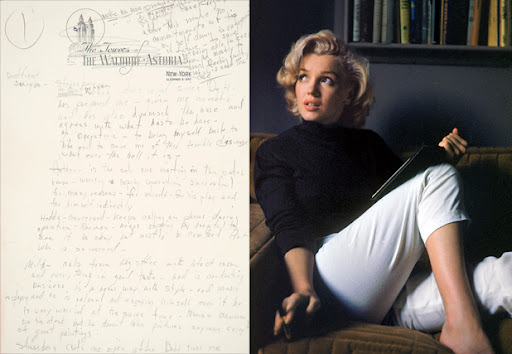
MONROE DOCTRINE
A dream record by Marilyn Monroe from 1955, when she lived at the Waldorf-Astoria, in Manhattan. Photograph, right, from Time & Life Pictures/Getty Images.
Excerpted from Fragments: Poems, Intimate Notes, Letters by Marilyn Monroe, edited by Stanley Buchthal and Bernard Comment, to be published October 12th by Farrar, Straus and Giroux, LLC (US), HarperCollins (Canada and UK); © 2010 by LSAS International, Inc.
She was always late for class, usually arriving just before they closed the doors. The teacher was strict about not entering in the middle of an exercise or, God forbid, in the middle of a scene. Slipping in without makeup, her luminous hair hidden under a scarf, she tried to make herself inconspicuous. She usually took a seat in the back of one of the dingy rooms in the Malin Studios, on 46th Street, smack in the middle of the theater district. When she raised her hand to speak, it was in a tiny wisp of a voice. She didn’t want to draw attention to herself, but it was hard for the other students not to know that the most famous movie star in the world was in their acting class. A few blocks away, above Loew’s State Theater, at 45th and Broadway, there was the other Marilyn—the one everyone knew—52 feet tall, in that infamous billboard advertising Billy Wilder’s The Seven Year Itch, a hot blast from the subway grating causing her white dress to billow up around her thighs, her face an explosion of joy.
When it was her turn to do an acting exercise focusing on sense memory, Marilyn took the floor in front of a small group of students. She was asked to remember a moment in her life, to recall the clothes she was wearing, to evoke the sights and smells of that memory. She described how she had felt about being alone in a room, years before, when an unnamed man walked in. Suddenly, her acting teacher admonished her, “Don’t do that. Just tell us what you hear. Don’t tell us how you feel.” Marilyn began to cry. Another student, an actress named Kay Leyder, recalled, “As she described her clothes … what she heard … the words that were said to her … she began crying, sobbing, until at the end of it she was really devastated.” Was this the real Marilyn Monroe: an insecure, shy, 29-year-old woman?
A handwriting expert takes a magnifying glass to Marilyn’s script, scrutinizing its deeper meaning.
Marilyn left the archive, along with all her personal effects, to her acting teacher Lee Strasberg, but it would take a decade for her estate to be settled. Strasberg died in February 1982, outliving his most famous student by 20 years, and in October 1999 his third wife and widow, Anna Mizrahi Strasberg, auctioned off many of Marilyn’s possessions at Christie’s, netting over $13.4 million, but the Strasbergs continue to license her image, which brings in millions more a year. The main beneficiary is the Lee Strasberg Theatre & Film Institute, on 15th Street off Union Square, in New York City. It is, you might say, the house that Marilyn built.
Several years after inheriting the collection, Anna Strasberg found two boxes containing the current archive, and she arranged for the contents to be published this fall around the world—in the U.S. as Fragments: Poems, Intimate Notes, Letters by Farrar, Straus and Giroux. The archive is a sensational discovery for Marilyn’s biographers and for her fans, who still want to rescue her from the taint of suicide, from the accusations of tawdriness, from the layers of misconceptions and distortions written about her over the years. Now at last we have an unfiltered look inside her mind.
“I picked up a chair and slammed it ...against the glass. It took a lot of banging. I went over with the glass concealed in my hand and sat.”
“Complete Subjection, Humiliation, Alonement”
Marilyn began taking private lessons with celebrated acting teacher Lee Strasberg in March 1955, encouraged by the acclaimed theater and movie director Elia Kazan, with whom she had had an affair. “Kazan said I was the gayest girl he ever knew,” she wrote to her analyst Dr. Ralph Greenson in the last and perhaps the most important letter found in this archive, “and believe me he has known many. But he loved me for one year and once rocked me to sleep one night when I was in great anguish. He also suggested that I go into analysis and later wanted me to work with his teacher, Lee Strasberg.”She was living at the Gladstone Hotel, on 52nd Street off Park Avenue, when she began working with Strasberg and embarked upon the psychoanalysis that was de rigueur for taking classes at the Actors Studio. Founded in 1947 by Kazan and directors Cheryl Crawford and Robert Lewis, it was the holy temple of the Method—acting exercises and scenes that focused on sense memories and “private moments” dredged from the actor’s life. Throughout the late 1940s and through much of the 1950s and 1960s, the Actors Studio was the most revered laboratory for stage actors in America. Its membership (one was not officially a “student” but a “member”) included a roster of the most compelling actors of the day: Marlon Brando, James Dean, Montgomery Clift, Julie Harris, Martin Landau, Dennis Hopper, Patricia Neal, Paul Newman, Eli Wallach, Ben Gazzara, Rip Torn, Kim Stanley, Anne Bancroft, Shelley Winters, Sidney Poitier, Joanne Woodward—who all brought those techniques into film.
Strasberg, born in 1901 in Austria-Hungary and raised on the Lower East Side of Manhattan, was a genius at analyzing an actor’s performance and a stern and often cold taskmaster. Short, bespectacled, and intense, he wasn’t, recalled Ellen Burstyn, “one for small talk.” For Marilyn, who grew up shunted from one foster family to another, not knowing who her father was, he became a beloved paternal figure, autocratic yet nurturing, and his acceptance of her as a private student bolstered her confidence and gave her the training to improve her acting, and turned her from a movie star (and punch line) into a true artist. But years later Kazan observed, “The more naïve and self-doubting the actors, the more total was Lee’s power over them. The more famous and the more successful these actors, the headier the taste of power for Lee. He found his perfect victim-devotee in Marilyn Monroe.”
Most important, this archive, far more deeply than the Inez Melson collection, made public in V.F. in October 2008, reveals a woman in search of herself, undergoing the harrowing experience of psychoanalysis for the first time, at the urging of Strasberg. The key players include Strasberg himself, her three psychiatrists—Dr. Margaret Hohenberg, Dr. Marianne Kris, and Dr. Ralph Greenson—and her third husband, Arthur Miller, whom she confesses to loving body and soul, but by whom she ultimately felt betrayed. These poems, musings, dreams, and correspondence also touch on her great fear of displeasing others, her chronic lateness, and three of the biggest traumas of her shortened life: one buried in her past, and two that took place a few years after she began studying with Strasberg. But they also reveal her growth both as an artist and a woman as she manages to cope with memories and disappointments that threatened to overwhelm her.
In a five-and-a-half-page typed document, Marilyn looked back on her early marriage to James Dougherty, an intelligent, attractive man five years her senior. They married on June 19, 1942, when she was just 16, and in this document she describes her feelings of loneliness and insecurity in that hastily agreed-to union, which was less of a love match than a way to keep Marilyn—then Norma Jeane Baker—out of the orphanage when her caretakers at the time, Grace and Erwin “Doc” Goddard, moved away from California. (There has also been speculation that Grace wanted to remove Norma Jeane from her husband’s too appreciative eye.)
Marilyn was not technically orphaned, as her mother, Gladys Monroe Baker, outlived her famous daughter, but because Gladys was a schizophrenic who spent years in and out of psychiatric hospitals, Marilyn was virtually abandoned, raised by various foster families and by Grace Goddard, a close friend of her mother’s. There were nearly two years when Marilyn was parked in an orphanage. Dougherty liked the idea of rescuing the shy, pretty girl, who left high school to marry him. Not surprisingly, the union failed, and they divorced on September 13, 1946.
“My relationship with him was basically insecure from the first night I spent alone with him,” she wrote in this long, undated, somewhat rambling memoir of that marriage, probably written by hand after undergoing analysis and later typed by her personal assistant, May Reis; the archivists suggest it was written when Norma Jeane was 17 and still married to Dougherty, but the emphasis on self-analysis seems to place it later in her life. It’s an intriguing document, peppered with misspellings, weaving the past with the present, at times reliving scenes from the marriage and her jealousy of Dougherty, at times stepping back and analyzing her emotional state of mind. She wrote,
I was greatly attracted to him as one of the [“only” is crossed out] few young men I had no sexual repulsion for besides which it gave me a false sense of security to feel that he was endowed with more overwelming qualities which I did not possess—on paper it all begins to sound terribly logical but the secret midnight meetings the fugetive glance stolen in others company the sharing of the ocean, moon & stars and air aloneness made it a romantic adventure which a young, rather shy girl who didn’t always give that impression because of her desire to belong & develope can thrive on—I had always felt a need to live up to that expectation of my elders.
Her memory of that marriage revolves around her fear that Dougherty preferred a former girlfriend, probably Doris Ingram, a Santa Barbara beauty queen, which triggered Marilyn’s sense of unworthiness and vulnerability to men:
Finding myself ofhandedly stood up snubbed my first feeling was not of anger—but the numb pain of rejection & hurt at the destruction of some sort of edealistic image of true love.
My first impulse then was one of complete subjection humiliation, alonement to the male counterpart. (all this thought & writting has made my hands tremble …
She then wonders if this exercise in memory and self-analysis is in fact good for her, writing:My first impulse then was one of complete subjection humiliation, alonement to the male counterpart. (all this thought & writting has made my hands tremble …
For someone like me its wrong to go through thorough self analisis—I do it enough in thought generalities enough.
Its not to much fun to know yourself to well or think you do—everyone needs a little conciet to carry them through & past the falls.
Its not to much fun to know yourself to well or think you do—everyone needs a little conciet to carry them through & past the falls.
“Best Finest Surgeon—Strasberg to Cut Me Open”
Included in the archive are several black “Record” notebooks—the slim, narrow, leather-bound diaries then favored by writers. The earliest of these notebooks begins with the words “Alone!!!!!!! I am alone I am always alone no matter what” in a slender, cursive script that leans dangerously forward, as if about to fall off a cliff.Marilyn apparently began recording her thoughts around 1951. Two years prior, broke and desperate, she had posed nude for photographer Tom Kelley, for a calendar series. After she signed a new contract with Fox, in December 1950, and the calendar photos surfaced, Marilyn deflected criticism by saying she had taken the job because “I was hungry.” The public forgave her. She possessed a quality that seemed to trigger rescue fantasies in men and women alike, even before the sad details of her fractured childhood were completely known. In part, Marilyn knew that to cast herself as an orphan stirred up pity and empathy.
By Christmas of 1954, she was living in New York City. She had already appeared in Niagara and Gentlemen Prefer Blondes, where she perfected her signature character, the vulnerable, “dumb,” sensual blonde, and, in How to Marry a Millionaire, with brilliant success. After that, Monroe’s fame was such that she supplanted in popularity the ultimate World War II pinup girl, Betty Grable, who shortly left Fox and bequeathed the largest dressing room on the lot to Marilyn. She had married Joe DiMaggio in January of that year, entertained troops in Korea, and filmed The Seven Year Itch. But the movie’s famous billboard displeased the puritanical “Yankee Clipper,” and the two filed for divorce in October, just nine months after marrying.
Encouraged by Strasberg, Marilyn began seeing Dr. Margaret Hohenberg as often as five times a week, first at Marilyn’s rooms at the Gladstone Hotel, then at Dr. Hohenberg’s office, at 155 East 93rd Street. The psychiatrist, an acquaintance of Strasberg’s, was a Brünnhilde type, a 57-year-old Hungarian immigrant complete with tightly wound braids and a Valkyrian bosom. Strasberg strongly believed that Marilyn needed to open up her unconscious and root through her troubled childhood, all in the service of her art. Between her sessions with Strasberg and with Dr. Hohenberg, she began recording some of those raked-up memories, including a devastating incident of sexual abuse. Described around 1955, in an Italian notebook whose pages are lined and numbered in green, this memory fully emerges, with the humiliating aftermath of being punished by her great-aunt Ida Martin, a strict, evangelical Christian paid by Grace Goddard to look after Norma Jeane for several months from 1937 to 1938. (Could this have been the sense-memory exercise that left her weeping in Strasberg’s acting class?) Marilyn wrote,
Ida—I have still
been obeying her—
it’s not only harmful
for me to do so
but unrealality because
life starts from Now
And later:been obeying her—
it’s not only harmful
for me to do so
but unrealality because
life starts from Now
working (doing my tasks that I
have set for myself)
On the stage—I will
not be punished for it
or be whipped
or be threatened
or not be loved
or sent to hell to burn with bad people
feeling that I am also bad.
or be afraid of my [genitals] being
or ashamed
exposed known and seen—
so what
or ashamed of my
sensitive feelings—
In April of 1955, Marilyn moved from the Gladstone to a three-room suite on the 27th floor of the Waldorf-Astoria, where she began writing down some of her memories and dreams on the hotel’s handsome Art Deco stationery. In a kind of stream-of-consciousness prose poem, she recounts a nightmare in which Strasberg is operating on her, with Dr. Hohenberg assisting:have set for myself)
On the stage—I will
not be punished for it
or be whipped
or be threatened
or not be loved
or sent to hell to burn with bad people
feeling that I am also bad.
or be afraid of my [genitals] being
or ashamed
exposed known and seen—
so what
or ashamed of my
sensitive feelings—
Best finest surgeon—Strasberg
to cut me open which I don’t mind since Dr. H
has prepared me—given me anaesthetic
and has also diagnosed the case and
agrees with what has to be done—
an operation—to bring myself back to
life and to cure me of this terrible dis-ease
whatever the hell it is—
The most terrifying part of the dream is what her surgeons find when they open her up:to cut me open which I don’t mind since Dr. H
has prepared me—given me anaesthetic
and has also diagnosed the case and
agrees with what has to be done—
an operation—to bring myself back to
life and to cure me of this terrible dis-ease
whatever the hell it is—
and there is absolutely nothing there—
Strasberg is
deeply disappointed but more even—
academically amazed
that he had made such a mistake. He
thought there was going
to be so much—more than he had ever
dreamed possible …
instead there was absolutely nothing—
devoid of
every human living feeling thing—
the only thing
that came out was so finely cut sawdust—like out of a raggedy ann doll—and the sawdust
spills
all over the floor & table and Dr. H is
puzzled
because suddenly she realizes that this is a
new type case. The patient … existing
of complete emptiness
Strasberg’s dreams & hopes for theater
are fallen.
Dr. H’s dreams and hopes for a permanent
psychiatric cure
is given up—Arthur is disappointed—
let down +
One of her greatest fears—disappointing those she cares about—is manifest here. The Arthur she refers to is, of course, Arthur Miller. She had met him years earlier in Hollywood, through Kazan.Strasberg is
deeply disappointed but more even—
academically amazed
that he had made such a mistake. He
thought there was going
to be so much—more than he had ever
dreamed possible …
instead there was absolutely nothing—
devoid of
every human living feeling thing—
the only thing
that came out was so finely cut sawdust—like out of a raggedy ann doll—and the sawdust
spills
all over the floor & table and Dr. H is
puzzled
because suddenly she realizes that this is a
new type case. The patient … existing
of complete emptiness
Strasberg’s dreams & hopes for theater
are fallen.
Dr. H’s dreams and hopes for a permanent
psychiatric cure
is given up—Arthur is disappointed—
let down +
Marilyn was re-introduced to the acclaimed playwright at the producer Charles Feldman’s home. Feldman had produced The Seven Year Itch, a huge success, and Marilyn had returned to Hollywood in February of 1956 to begin work on Bus Stop, directed by Josh Logan. She was instantly smitten by the Pulitzer Prize—winning author of All My Sons, Death of a Salesman, The Crucible, and A View from the Bridge, who was still married to his first wife, Mary Slattery, at the time. Miller possessed those traits she most admired: intellectual and artistic achievement, high seriousness. They wed in a civil ceremony on June 29, 1956, Marilyn having converted to Judaism. Two days later, Lee Strasberg acted as her father, giving the bride away in an intimate Jewish wedding.
At first, she was deliriously happy, moving back to New York with her new husband to take up residence in her dazzlingly white apartment at 2 Sutton Place, to which she had moved after leaving the Waldorf-Astoria, and then on to 444 East 57th Street, in an apartment with a book-lined living room, complete with fireplace and piano. In the Italian, green, engraved diary, she wrote,
I am so concerned
about protecting Arthur
I love him—and he is the
only person—human being I have
ever known that I could love not only
as a man to which I am attracted to
practically
out of my senses about—but he [is] the only
person … that I trust as
muchas myself—because when I do trust my-
self (about certain things) I do fully
about protecting Arthur
I love him—and he is the
only person—human being I have
ever known that I could love not only
as a man to which I am attracted to
practically
out of my senses about—but he [is] the only
person … that I trust as
muchas myself—because when I do trust my-
self (about certain things) I do fully
Marilyn writes of her early sexual abuse: “I will not be punished for it or be whipped or be threatened or not be loved or sent to hell to burn.”
They were probably happiest in the summer of 1957, spent in a rented house in Amagansett, on Long Island, where they swam and took long walks on the beach. She looks especially radiant in photographs from this era, when she happily entered into Miller’s world—for example, attending a luncheon given by the novelist Carson McCullers for the writer Isak Dinesen. Marilyn was gay and witty in this company, easily holding her own—her vitality and innocence reminded Dinesen of a wild lion cub. She became friends with writer Truman Capote and met some of her literary heroes, such as poet Carl Sandburg and novelist Saul Bellow, with whom she dined at the Ambassador Hotel on the occasion of the Chicago premiere of Some Like It Hot. Bellow was bowled over by her.Several photographs taken of Marilyn earlier in her life—the ones she especially liked—show her reading. Eve Arnold photographed her for Esquire magazine in a playground in Amagansett reading James Joyce’s Ulysses. Alfred Eisenstaedt photographed her, for Life, at home, dressed in white slacks and a black top, curled up on her sofa, reading, in front of a shelf of books—her personal library, which would grow to 400 volumes. In another photograph, she’s on a pulled-out sofa bed reading the poetry of Heinrich Heine.
If some photographers thought it was funny to pose the world’s most famously voluptuous “dumb blonde” with a book—James Joyce! Heinrich Heine!—it wasn’t a joke to her. In these newly discovered diary entries and poems, Marilyn reveals a young woman for whom writing and poetry were lifelines, the ways and means to discover who she was and to sort through her often tumultuous emotional life. And books were a refuge and a companion for Marilyn during her bouts of insomnia.
In one of the handful of sweet and affecting poems included in this archive, Marilyn, still in the first flush of her love for Miller and imagining what he might have been like as a young boy, wrote a poem about him:
my love sleeps besides me—
in the faint light—I see his manly jaw
give way—and the mouth of his
boyhood returns
with a softness softer
its sensitiveness trembling
in stillness
his eyes must have look out
wonderously from the cave of the little
boy—when the things he did not understand—
he forgot
The poem then turns dark, a premonition, perhaps, of how the marriage would end:in the faint light—I see his manly jaw
give way—and the mouth of his
boyhood returns
with a softness softer
its sensitiveness trembling
in stillness
his eyes must have look out
wonderously from the cave of the little
boy—when the things he did not understand—
he forgot
but will he look like this when he is dead
oh unbearable fact inevitable
yet sooner would I rather his love die
than/or him?
oh unbearable fact inevitable
yet sooner would I rather his love die
than/or him?
“Ah Peace I Need You—Even a Peaceful Monster”
But after she and Miller traveled to England for four months for the filming of The Prince and the Showgirl, with Laurence Olivier, things began to sour. They moved into a magnificent manor called Parkside House, in Surrey, outside of London. On paper, it was an idyll: here she was producing a film directed by and starring one of the most respected actors of his generation, and living in a grand country house with the man she most loved. She couldn’t have felt more fulfilled and vindicated as an artist, until a chance discovery undermined her fragile confidence in herself and her trust in her husband. It was at Parkside House that Marilyn stumbled upon a diary entry of Miller’s in which he complained that he was “disappointed” in her, and sometimes embarrassed by her in front of his friends.Marilyn was devastated. One of her greatest fears—that of disappointing those she loved—had come true. His betrayal confirmed what she’d “always been deeply terrified” of: “To really be someone’s wife since I know from life one cannot love another, ever, really,” as she wrote in another “Record” journal entry.
After this discovery, Marilyn found it so difficult to work that she flew in Dr. Hohenberg from New York. She was having trouble sleeping, relying on barbiturates. On Parkside House stationery, she wrote one night after Miller had gone to bed:
on the screen of pitch blackness
comes/reappears the shapes of monsters
my most steadfast companions …
and the world is sleeping
ah peace I need you—even a
peaceful monster.
In the summer of 1957, the couple bought a country house in Roxbury, Connecticut, near where Miller had lived with his first wife. Any love that remained seemed to go out of the marriage. Nonetheless, she had accompanied her husband to Washington, D.C., in the spring and stood by his side as he faced down the House Un-American Activities Committee by refusing to name former Communist Party members. Many believe that Monroe’s popularity saved him from being destroyed by HUAC’s witch hunt, which blacklisted many show-business people and ruined their lives.comes/reappears the shapes of monsters
my most steadfast companions …
and the world is sleeping
ah peace I need you—even a
peaceful monster.
That winter Miller worked on adapting one of his short stories for the screen, “The Misfits,” while Marilyn grappled with her feelings of disappointment and loss:
Starting tomorrow I will take care of myself for that’s all I really have and as I see it now have ever had. Roxbury—I’ve tried to imagine spring all winter—it’s here and I still feel hopeless. I think I hate it here because there is no love here anymore…
In every spring the green [of the ancient maples] is too sharp—though the delicacy in their form is sweet and uncertain—it puts up a good struggle in the wind—trembling all the while… I think I am very lonely—my mind jumps. I see myself in the mirror now, brow furrowed—if I lean close I’ll see—what I don’t want to know—tension, sadness, disappointment, my [“blue” is crossed out] eyes dulled, cheeks flushed with capillaries that look like rivers on maps—hair lying like snakes. The mouth makes me the sadd[est], next to my dead eyes…
When one wants to stay alone as my love (Arthur) indicates the other must stay apart.
In 1958, Marilyn moved back to Los Angeles to begin work in Some Like It Hot, which—despite her chronic lateness and other difficulties on the set—would turn out to be her greatest and most successful comedy. She began recording her musings and poems in a red spiral Livewire notebook, poems that took a dark turn. Here’s one such fragment, written under the ironic heading “After one year of analysis”:In every spring the green [of the ancient maples] is too sharp—though the delicacy in their form is sweet and uncertain—it puts up a good struggle in the wind—trembling all the while… I think I am very lonely—my mind jumps. I see myself in the mirror now, brow furrowed—if I lean close I’ll see—what I don’t want to know—tension, sadness, disappointment, my [“blue” is crossed out] eyes dulled, cheeks flushed with capillaries that look like rivers on maps—hair lying like snakes. The mouth makes me the sadd[est], next to my dead eyes…
When one wants to stay alone as my love (Arthur) indicates the other must stay apart.
Help help
Help
I feel life coming closer
when all I want
Is to die.
Scream—
You began and ended in air
but where was the middle?
Marilyn had left Dr. Hohenberg in the spring of 1957, after she’d fired Milton Greene from her production company. (Greene had also been a patient of Dr. Hohenberg’s.) She began analysis with a new psychiatrist, Dr. Marianne Kris, a Viennese woman who was approved by Strasberg. Marilyn would remain Dr. Kris’s patient until 1961, and she continued to write down memories and fragments of self-analysis to show to her new psychotherapist. One such note was written two days after the 10th birthday of Arthur Miller’s daughter Jane, from his first marriage. Marilyn had grown close to Jane and her brother Bobby. Perhaps thinking about her stepdaughter triggered this brief memory of her mother, whose confinement in a mental hospital led Marilyn to fear that she too would end up institutionalized:Help
I feel life coming closer
when all I want
Is to die.
Scream—
You began and ended in air
but where was the middle?
“I have always been deeply terrified to really be someone’s wife since I know from life one cannot love another, ever, really.”
For Kris
Sept. 9
—Remember, somehow, how—
Mother always tried to
get me to “go out” as
though she felt I
were too unadventurous.
She wanted me even
to show a cruelty
toward woman. This
in my teens. In return,
I showed her that I
was faithful to her.
In 1960, Marilyn remained in Hollywood to star in Let’s Make Love, with French heartthrob Yves Montand. Feeling shut out of her husband’s affections and esteem, she had an affair with her co-star, causing something of a feeding frenzy in the press. On the recommendation of Dr. Kris, she started analysis in Los Angeles with Dr. Ralph Greenson, a prominent psychiatrist and strict Freudian analyst who treated many celebrities, among them Judy Garland, Frank Sinatra, and pianist Oscar Levant. Just as she had with the Strasbergs, Marilyn became a kind of surrogate daughter to Greenson, and he often took her into his home as part of an unorthodox form of therapy—or, perhaps, because he too had become infatuated with her. He saw her every day, sometimes in sessions that lasted five hours. The treatment, often called adoption therapy, is very much discredited today.Sept. 9
—Remember, somehow, how—
Mother always tried to
get me to “go out” as
though she felt I
were too unadventurous.
She wanted me even
to show a cruelty
toward woman. This
in my teens. In return,
I showed her that I
was faithful to her.
Miller completed his screenplay for The Misfits, with the central role of a wounded young woman, who falls in love with a much older man, based, not surprisingly, on Marilyn. In July of 1960, filming began in the Nevada desert, under John Huston’s direction, with Marilyn, Clark Gable, Montgomery Clift, Thelma Ritter, and Eli Wallach in key roles. Miller was on location, watching as his wife began to unravel in the blistering heat. On the set he met and fell in love with a photographic archivist on the film, Inge Morath, who would become his third wife. On November 11, 1960, Marilyn and Arthur Miller’s separation was announced to the press.
Three months later, back in New York, emotionally exhausted and under Dr. Kris’s care, Marilyn was committed to Payne Whitney’s psychiatric ward. What was supposed to have been a prescribed rest cure for the overwrought and insomniac actress turned out to be the most harrowing three days of her life.
Kris had driven Marilyn to the sprawling, white-brick New York Hospital—Weill Cornell Medical Center, overlooking the East River at 68th Street. Swathed in a fur coat and using the name Faye Miller, she signed the papers to admit herself, but she quickly found she was being escorted not to a place where she could rest but to a padded room in a locked psychiatric ward. The more she sobbed and begged to be let out, banging on the steel doors, the more the psychiatric staff believed she was indeed psychotic. She was threatened with a straitjacket, and her clothes and purse were taken from her. She was given a forced bath and put into a hospital gown.
On March 1 and 2, 1961, Marilyn wrote an extraordinary, six-page letter to Dr. Greenson vividly describing her ordeal: “There was no empathy at Payne-Whitney—it had a very bad effect—they asked me after putting me in a ‘cell’ (I mean cement blocks and all) for very disturbed depressed patients (except I felt I was in some kind of prison for a crime I hadn’t committed. The inhumanity there I found archaic … everything was under lock and key … the doors have windows so patients can be visible all the time, also, the violence and markings still remain on the walls from former patients.)”
“Peter He Might Harm Me, Poison Me”
A psychiatrist came in and gave her a physical exam, “including examining the breast for lumps.” She objected, telling him that she’d had a complete physical less than a month before, but that didn’t deter him. After being unable to make a phone call, she felt imprisoned, and so she turned to her actor’s training to find a way out: “I got the idea from a movie I made once called ‘Don’t Bother to Knock,’ ” she wrote to Greenson—an early film in which she had played a disturbed teenage babysitter.I picked up a light-weight chair and slammed it … against the glass intentionally. It took a lot of banging to get even a small piece of glass—so I went over with the glass concealed in my hand and sat quietly on the bed waiting for them to come in. They did, and I said to them “if you are going to treat me like a nut I’ll act like a nut.”
She threatened to harm herself with the glass if they didn’t let her out, but cutting herself was “the furthest thing from my mind at that moment since you know Dr. Greenson I’m an actress and would never intentionally mark or mar myself, I’m just that vain. Remember when I tried to do away with myself I did it very carefully with ten seconal and ten tuonal and swallowed them with relief (that’s how I felt at the time.)”When she refused to cooperate with the staff, “two hefty men and two hefty women” picked her up by all fours and carried her in the elevator to the seventh floor of the hospital. (“I must say that at least they had the decency to carry me face down.… I just wept quietly all the way there,” she wrote.)
She was ordered to take another bath—her second since arriving—and then the head administrator came in to question her. “He told me I was a very, very sick girl and had been a very, very sick girl for many years.”
Dr. Kris, who had promised to see her the day after her confinement, failed to show up, and neither Lee Strasberg nor his wife, Paula, to whom she finally managed to write, could get her released, as they were not family. It was Joe DiMaggio who rescued her, swooping in against the objections of the doctors and nurses and removing her from the ward. (He and Marilyn had had something of a reconciliation that Christmas, when DiMaggio sent her “a forest-full of poinsettias.”)
It should be noted that this is one of the few letters that have already seen the light of day. It was quoted almost in its entirety in Donald Spoto’s Marilyn Monroe: The Biography, published in 1993. Spoto says he got it from the estate of May Reis—Marilyn’s personal assistant from the 1950s until her death—who had typed the letter and kept a copy. Nonetheless, it is fascinating to be able to read the facsimile of this long-sought-after document and to see some of the elements left out of Spoto’s book, such as an intriguing postscript that reads:
Someone when I mentioned his name you used to frown with your moustache and look up at the ceiling. Guess who? He has been (secretly) a very tender friend. I know you won’t believe this but you must trust me with my instincts. It was sort of a fling on the wing. I had never done that before but now I have—but he is very unselfish in bed.
From Yves [Montand] I have heard nothing—but I don’t mind since I have such a strong, tender, wonderful memory.
I am almost weeping.
In November 1961, Marilyn met John F. Kennedy at the Santa Monica home of actor Peter Lawford, the president’s brother-in-law. The following year, in February, she bought her first home, in fashionable Brentwood. She began filming her last movie, Something’s Got to Give, directed by George Cukor, in April of 1962. The now famous outtakes from the unfinished film—Marilyn rising naked and un-shy from a swimming pool—show her fit and radiant, at the top of her game. Her chronic lateness and absences from the set, however—something even Strasberg couldn’t cure her of—caused her to be fired from the picture, which was never completed. Four months later, on August 5, 1962, she would be found dead from a drug overdose in her Brentwood home, an apparent suicide.From Yves [Montand] I have heard nothing—but I don’t mind since I have such a strong, tender, wonderful memory.
I am almost weeping.
Even with the revelations and unexpected pleasures of this soon-to-be-published archive, the deep mystery of her death remains. For those who believe that Marilyn’s death was indeed a suicide, there are many indications of her emotional fragility and a description of a past suicide attempt. “Oh Paula,” she wrote in an undated note to Paula Strasberg, “I wish I knew why I am so anguished. I think maybe I’m crazy like all the other members of my family were, when I was sick I was sure I was. I’m so glad you are with me here!”
For those who believe she died of an accidental overdose, mixing prescribed barbiturates with alcohol, the archive contains evidence of her optimism, her feeling that she has come to rely on herself and will solve her problems through work and her capable, businesslike plans for the future.
the feeling of violence I’ve had lately
about being afraid
of Peter he might
harm me,
poison me, etc.
why—strange look in his eyes—strange
behavior
in fact now I think I know
why he’s been here so long
because I have a need to
be frighten[ed]—and nothing really
in my personal relationships
(and dealings) lately
have been frightening me—except
for him—I felt very uneasy at different
times with him—the real reason
I was afraid of him—is because I believe
him to be homosexual—not in the
way I love & respect and admire [Jack]
who I feel feels I have talent
and wouldn’t be jealous
of me because I wouldn’t
really want to
be me
whereas Peter wants
to be a woman—and
would like to be me—I think
Marilyn and Lawford, the British actor and bon vivant, had first met in Hollywood in the 1950s. “Jack” is probably Jack Cole, the dancer-choreographer who befriended and coached Marilyn on Gentlemen Prefer Blondes and There’s No Business Like Show Business. (She would not meet “Jack” Kennedy until five years later.)about being afraid
of Peter he might
harm me,
poison me, etc.
why—strange look in his eyes—strange
behavior
in fact now I think I know
why he’s been here so long
because I have a need to
be frighten[ed]—and nothing really
in my personal relationships
(and dealings) lately
have been frightening me—except
for him—I felt very uneasy at different
times with him—the real reason
I was afraid of him—is because I believe
him to be homosexual—not in the
way I love & respect and admire [Jack]
who I feel feels I have talent
and wouldn’t be jealous
of me because I wouldn’t
really want to
be me
whereas Peter wants
to be a woman—and
would like to be me—I think
If this archive doesn’t quite solve the enigma of Marilyn Monroe’s death, it does go deeper than we have ever been into the mystery of her life. As Lee Strasberg noted in his eloquent eulogy, “In her eyes and mine, her career was just beginning. The dream of her talent, which she had nurtured as a child, was not a mirage.”
FROM THE ARCHIVE
For these related stories, visit VF.COM/ARCHIVEDiscovery of Marilyn’s secret papers (Sam Kashner, October 2008) Marilyn and acting teacher Lee Strasberg (Patricia Bosworth, June 2003) Arthur Miller on anti-Semitism (October 2001) Arthur Miller’s forgotten son (Suzanna Andrews, September 2007) Interview with Miller (James Kaplan, November 1991) Documents excerpted from Fragments: Poems, Intimate Notes, Letters, by Marilyn Monroe, edited by Stanley Buchthal and Bernard Comment, to be published this month by Farrar, Straus and Giroux, L.L.C. (U.S.), HarperCollins (Canada and U.K.); © 2010 by LSAS International, Inc.
http://www.vanityfair.com/hollywood/features/2010/11/marilyn-monroe-201011?currentPage=all
The Other Charles Lindbergh

The Other Charles Lindbergh
November 26, 2010"This act establishes the most gigantic trust on earth.... When the President signs this act the invisible government by the money powers, proven to exist by the Money Trust investigation, will be legalized."
Charles A. Lindbergh Sr., father of the famous aviator, was the fiercest opponent of the Federal Reserve Act. A nation that has been subverted and colonized by an international financial cartel is denied knowledge of its rightful heroes. Charles A. Lindbergh Sr. (1859-1924) was one of its greatest.
Excerpt From "The New American"
Exhaustive study of banking led C.A. to believe there was a powerful conspiracy working to centralize financial control in the hands of a few, and he did his best to expose it.
"The remedy for our social evils," he said, "does not so much consist in changing the system of government as it does in increasing the general intelligence of the people so that they may know how to govern.... If they do not learn how to govern themselves intelligently, Socialism will be the result."
Lindbergh found secret collusion between Southern and English bankers at the time of the Civil War, citing proofs in his 1913 book, "Banking and Currency and the Money Trust". He published there the text of the 1862 "Hazard Circular," which revealed how labor would henceforth be controlled by the amount of currency the bankers permitted in the market, since chattel slavery would be abolished by the war. ...
Lindbergh accused Members of Congress of meeting in secret to determine which currency bill would pass and what type of Federal Reserve System should be established to please the Establishment.
"The correct name for a caucus," contended the Congressman, "is 'conspiracy.' The conspiracy here is to usurp the powers of Congress, and do as little for the people as it is thought the people will accept. I have been fighting the caucus system and the secret meeting of committees ever since I came to Congress."
Time and again the plans of the money manipulators had to be revised because of exposure by Congressman Lindbergh and his associates. Indeed, according to "The Lindberghs" by Lynn and Dora Haines, the Congressman was himself offered a bribe of two million dollars -- big money today, but then an astronomical sum -- to stop the circulation of his book, Banking and Currency and the Money Trust.
A question arises. Why didn't the Insiders of the banking establishment, "go out and defeat him? They tried repeatedly. I once asked an Old Guarder why they didn't succeed: His explanation was interesting, and possibly had some significance. 'We spent so much money,' he said, 'trying to lick Lindbergh that the district became too prosperous to care about a change.'"
Discussing the Glass-Owen Bill, now known as the Federal Reserve Act, Representative Lindbergh and a few others noted on December 22, 1913, that it was nothing more than a resurrection of the repudiated Aldrich plan. "This act establishes the most gigantic trust on earth.... When the President signs this act the invisible government by the money powers, proven to exist by the Money Trust investigation, will be legalized."
The Money Trust referred to "An established and well-defined identity and community of interest between a few leaders of finance which has been created and is held together through stock holdings, interlocking directorates, and other forms of domination over banks, trust companies, railroads, public service and industrial corporations, and which resulted in a vast and growing concentration of control of money and credit in the hands of a comparatively few men...."
Named as "the most active agents in forwarding and bringing about" this concentration were: J.P. Morgan & Company; First National Bank of New York; National City Bank of New York; Lee, Higginson & Company of Boston and New York; Kidder, Peabody & Company of Boston and New York; and, Kuhn, Loeb & Company.
Lindbergh explained that this "Money Trust caused the 1907 panic, and thereby forced Congress to create a National Monetary Commission, which drew a bill in the interests of the Money Trust, but Congress did not dare to pass the bill as coming from that Commission. The main features of that bill, however, were copied into this [Glass-Owen] bill. In 1912 I made a speech predicting that that would be done, and, further, that the Money Trust would cause a money stringency in order to force its bill through Congress. All this has now taken place. This bill is passed by Congress as a Christmas present to the Money Trust."
The invisible government, Lindbergh said, had come up with a new scheme "to make the people believe that the trusts are opposed to the very thing that the trusts favor. It is assumed that the people will favor what the trusts openly claim to be against. Smoothly the Money Trust has played a game of fake opposition...." And Congress obligingly tossed the conspirators into their favorite briar patch.
The bill that created the Federal Reserve System was nothing more than the Aldrich plan in disguise, which Lindbergh opposed because "Wall Street, backed by Morgan, Rockefeller, and others would control the Reserve Association, and those again, backed by all the deposits and disbursements of the United States, and again backed by the deposits of the national banks holding the private funds of the people, which is provided in the Aldrich plan, would be the most wonderful financial machinery that finite beings could invent to take control of the world." In fact, shortly before the end of his congressional career, C.A. Lindbergh formally moved to impeach the members of the Federal Reserve Board and offered a 15-count indictment of their conspiracy. The motion was buried in the Judiciary Committee.
Now, according to The Lindberghs, there were "detectives shadowing him much of the time, and he was given to understand that it would be safer for him if he was to change his tactics. In speaking of this to a friend, he said: 'They ought to know by this time they can't scare me that way, but they may get me yet.' "In a subsequent campaign, when shots were fired at the Lindbergh car, a companion declared that "C.A. sat up straight" and directed the driver not to drive so fast lest "they will think we are scared."
Faithful to the End
In the end it was Lindbergh's anti-conspiracy foreign policy that helped the conspirators to "get" him. A proponent of neutrality in World War I, he wondered how America could, on the one hand, follow the Monroe Doctrine and, on the other, involve itself in a foreign war outside our hemisphere. But he was strongly for military preparedness and certainly no pacifist. "Convinced that an inner circle,' composed chiefly of financial interests, was promoting American intervention, Lindbergh became clearly identified as an opponent of war throughout the neutrality period," reports Bruce Larson. Lindbergh warned: "It is my belief that we are going in as soon as the country can be sufficiently propagandized into the war mania."
Congressman Lindbergh had never been one to vote the Party Line. Indeed, he came to realize "the plain truth is that neither of these great parties, as at present led and manipulated by an 'invisible government,' is fit to manage the destinies of a great people, and this fact is well understood by all who have had the time and have used it to investigate."
Seeking to increase his influence by going directly to the people, Lindbergh announced he was stepping down from Congress. He would never again hold public office, though he later ran for both Governor of Minnesota and U.S. Senator, the former campaign (in 1918) being one of the dirtiest in American history.
Once the U.S. joined the war, Lindbergh supported the effort: "the thing has been done, and however foolish it has been, we must all be foolish and unwise together, and fight for our country." He offered his services to the Governor and the President, and was asked to serve on the War Industries Board. That is, until his political enemies questioned his loyalty and used war hysteria to force C.A. to resign. One of the points of contention in the 1918 gubernatorial race centered on a little-circulated book Lindbergh published in July of 1917, entitled "Why Is Your Country at War," written, C.A. said, "to emphasize independence." It was widely, and falsely, labeled as seditious.
A national campaign was launched to destroy C.A. and be rid of his conspiracy theories forever. The Non-Partisan League, with which he was then associated, was frequently denied the right to assembly; and mobs raged against Lindbergh, who was stoned and hanged in effigy. Plates of his book, and the even more important earlier one on the banking conspiracy, were destroyed. Lindbergh supporters were often arrested without warrants. The New York Times called the distinguished C.A. Lindbergh "a sort of Gopher Bolshevik," and the Duluth Herald titled one of their typical anti-C.A. editorials "Traitor or Ass."
After the war, C.A. Lindbergh was rightfully critical of the Versailles Treaty, noting that President Wilson "has his pay now for trying to tie us to a world war machine." A losing race for Senator in 1923, running on the Farmer-Labor ticket with young Charles flying him about in an airplane, was C.A.'s last campaign. A year later, he was dead. From a plane above the Lindbergh homestead, his son returned the ashes of C.A. Lindbergh's cremated body to the land he loved.
--------
"The Other Charles Lindbergh" is taken from an article that originally appeared in the May 1977 issue of American Opinion, a precursor to THE NEW AMERICAN. The original article, entitled 'Lindbergh: Two Generations of Heroism," covered the lives of both the elder Lindbergh and his famous aviator son; the article as it appears here focuses on C.A. Lindbergh Sr.
http://www.henrymakow.com/the_other_charles_lindbergh.html
Is the Growing Police State Worth Fighting For?
In 43 BC, over 2,000 years ago, warring consuls Antony, Lepidus, and Octavian were duking it out with each other over control of Rome following Julius Caesar’s assassination the prior March.
Each had legions at his disposal, and Rome’s terrified Senate sat on its hands waiting for the outcome.
Ultimately, the three men chose to unite their powers and rule Rome together in what became known as the Second Triumvirate. This body was established by a law named Lex Titia on this date (give or take depending on how you convert the Roman calendar) in 43 BC.
The foundation of the Second Triumvirate is of tremendous historical importance: As the group wielded dictatorial powers, it represents the final nail in the coffin in Rome’s transition from republic to malignant autocracy.
The Second Triumvirate expired after 10 years, upon which Octavian waged war on his partners once again, resulting in Mark Antony’s famed suicide with Cleopatra in 31 BC. Octavian was eventually rewarded with rich title and nearly supreme power, and he is generally regarded as Rome’s first emperor.
Things only got worse from there. Tiberius, Octavian’s successor, was a paranoid deviant with a lust for executions. He spent the last decade of his reign completely detached from Rome, living in Capri.
Following Tiberius was Caligula, infamous for his moral depravity and insanity. According to Roman historians Suetonius and Cassius Dio, Caligula would send his legions on pointless marches and turned his palace into a bordello of such repute that it inspired the 1979 porno film named for him.
Caligula was followed by Claudius, a stammering, slobbering, confused man as described by his contemporaries. Then there was Nero, who not only managed to burn down his city but was also the first emperor to debase the value of Rome’s currency.
You know the rest of the story — Romans watched their leadership and country get worse and worse.
All along the way, there were two types of people: The first group was folks that figured, “This has GOT to be the bottom; it can only get better from here.” Their patriotism was rewarded with reduced civil liberties, higher taxes, insane despots, and a polluted currency.
The other group consisted of people who looked at the warning signs and thought, “I have to get out of here.” They followed their instincts and moved on to other places where they could build their lives, survive, and prosper.
I’m raising this point because I’d like to open a debate. Some consider the latter idea of expatriating to be akin to ‘running away.’ I recall a rather impassioned comment from a reader who suggested, “leaving, i.e. running away, is certainly not the proper response.”
I find this logic to be flawed.
While the notion of staying and ‘fighting’ is a noble idea, bear in mind that there is no real enemy or force to fight. The government is a faceless bureaucracy that’s impossible attack. People who try only discredit their argument because they become marginalized as fringe lunatics.
Remember John Stack? He’s the guy who flew his airplane into the IRS building in Austin, Texas earlier this year because he had a serious philosophical disagreement over tax issues.
While his ideas may have had intellectual merit, they were immediately dismissed due to his murderous tactics. Violence is rarely the answer, and it often has the opposite effect as intended, frequently serving to bolster support for the government instead of raising awareness of its shortcomings.
Unless/until government paramilitaries start duking it out with citizen militia groups in the streets, this is an ideological battle... and it’s an uphill battle at best.
Government controlled educational systems institutionalize us from childhood that governments are just, and that we should all subordinate ourselves to authority and to the greater good that they dictate in their sole discretion.
You’re dealing with a mob mentality, plain and simple. Do you want to waste limited resources (time, money, energy) trying to convince your neighbor that s/he should no not expect free money from the government?
You could spend a lifetime trying to change ideology and not make a dent; people have to choose for themselves to wake up, it cannot be forced upon them. And until that happens, they’re going to keep asking for more security and more control because it’s the way their values have been programmed.
When you think about it, what we call a ‘country’ is nothing more than a large concentration of people who share common values. Over time, those values adjust and evolve. Today, cultures in many countries value things like fake security, subordination, and ignorance over freedom, independence, and awareness.
When it appears more and more each day that those common values diverge from your own, all that’s left of a country are irrelevant, invisible lines on a map. I don’t find these worth fighting for.
Nobody is born with a mandatory obligation to invisible lines on a map. Our fundamental obligation is to ourselves, our families, and the people that we choose to let into our circles... not to a piece of dirt that’s controlled by mob-installed bureaucrats.
Moving away, i.e. making a calculated decision to seek greener pastures elsewhere, is not the same as ‘running away’... and I would argue that if you really want to affect change in your home country, moving away is the most effective course of action.
The government beast in your home country feeds on debt and taxes, and the best way to win is for bright, productive people to move away with their ideas, labor, and assets. This effectively starves the beast and accelerates its collapse. Then, when the smoke clears, you can move back and help rebuild a free society.
Regards,
Simon Black
Each had legions at his disposal, and Rome’s terrified Senate sat on its hands waiting for the outcome.
Ultimately, the three men chose to unite their powers and rule Rome together in what became known as the Second Triumvirate. This body was established by a law named Lex Titia on this date (give or take depending on how you convert the Roman calendar) in 43 BC.
The foundation of the Second Triumvirate is of tremendous historical importance: As the group wielded dictatorial powers, it represents the final nail in the coffin in Rome’s transition from republic to malignant autocracy.
The Second Triumvirate expired after 10 years, upon which Octavian waged war on his partners once again, resulting in Mark Antony’s famed suicide with Cleopatra in 31 BC. Octavian was eventually rewarded with rich title and nearly supreme power, and he is generally regarded as Rome’s first emperor.
Things only got worse from there. Tiberius, Octavian’s successor, was a paranoid deviant with a lust for executions. He spent the last decade of his reign completely detached from Rome, living in Capri.
Following Tiberius was Caligula, infamous for his moral depravity and insanity. According to Roman historians Suetonius and Cassius Dio, Caligula would send his legions on pointless marches and turned his palace into a bordello of such repute that it inspired the 1979 porno film named for him.
Caligula was followed by Claudius, a stammering, slobbering, confused man as described by his contemporaries. Then there was Nero, who not only managed to burn down his city but was also the first emperor to debase the value of Rome’s currency.
You know the rest of the story — Romans watched their leadership and country get worse and worse.
All along the way, there were two types of people: The first group was folks that figured, “This has GOT to be the bottom; it can only get better from here.” Their patriotism was rewarded with reduced civil liberties, higher taxes, insane despots, and a polluted currency.
The other group consisted of people who looked at the warning signs and thought, “I have to get out of here.” They followed their instincts and moved on to other places where they could build their lives, survive, and prosper.
I’m raising this point because I’d like to open a debate. Some consider the latter idea of expatriating to be akin to ‘running away.’ I recall a rather impassioned comment from a reader who suggested, “leaving, i.e. running away, is certainly not the proper response.”
I find this logic to be flawed.
While the notion of staying and ‘fighting’ is a noble idea, bear in mind that there is no real enemy or force to fight. The government is a faceless bureaucracy that’s impossible attack. People who try only discredit their argument because they become marginalized as fringe lunatics.
Remember John Stack? He’s the guy who flew his airplane into the IRS building in Austin, Texas earlier this year because he had a serious philosophical disagreement over tax issues.
While his ideas may have had intellectual merit, they were immediately dismissed due to his murderous tactics. Violence is rarely the answer, and it often has the opposite effect as intended, frequently serving to bolster support for the government instead of raising awareness of its shortcomings.
Unless/until government paramilitaries start duking it out with citizen militia groups in the streets, this is an ideological battle... and it’s an uphill battle at best.
Government controlled educational systems institutionalize us from childhood that governments are just, and that we should all subordinate ourselves to authority and to the greater good that they dictate in their sole discretion.
You’re dealing with a mob mentality, plain and simple. Do you want to waste limited resources (time, money, energy) trying to convince your neighbor that s/he should no not expect free money from the government?
You could spend a lifetime trying to change ideology and not make a dent; people have to choose for themselves to wake up, it cannot be forced upon them. And until that happens, they’re going to keep asking for more security and more control because it’s the way their values have been programmed.
When you think about it, what we call a ‘country’ is nothing more than a large concentration of people who share common values. Over time, those values adjust and evolve. Today, cultures in many countries value things like fake security, subordination, and ignorance over freedom, independence, and awareness.
When it appears more and more each day that those common values diverge from your own, all that’s left of a country are irrelevant, invisible lines on a map. I don’t find these worth fighting for.
Nobody is born with a mandatory obligation to invisible lines on a map. Our fundamental obligation is to ourselves, our families, and the people that we choose to let into our circles... not to a piece of dirt that’s controlled by mob-installed bureaucrats.
Moving away, i.e. making a calculated decision to seek greener pastures elsewhere, is not the same as ‘running away’... and I would argue that if you really want to affect change in your home country, moving away is the most effective course of action.
The government beast in your home country feeds on debt and taxes, and the best way to win is for bright, productive people to move away with their ideas, labor, and assets. This effectively starves the beast and accelerates its collapse. Then, when the smoke clears, you can move back and help rebuild a free society.
Regards,
Simon Black
Subscribe to:
Posts (Atom)